
Prospect, Refuge, and the Architecture of Attention
Employees consistently identify focus as one of their greatest workplace needs, yet creating environments that reliably support concentration remains one of the biggest challenges in workplace design. But our new pilot study suggests that our brains may be responding to workplace layouts in ways we don’t consciously recognize. Studying adults with inattentive type ADHD helped make these effects more visible, revealing insights with broader relevance for workplace design.
For decades, architects and designers have relied on Prospect-Refuge Theory to explain why some spaces simply feel better than others. First proposed in 1975 by geographer Jay Appleton in “The Experience of Landscape,” the theory suggests that people prefer environments where they can comfortably see their surroundings — known as prospect — while also feeling protected from behind — referred to as refuge. Appleton linked this preference to a survival instinct: the need to observe and be aware of potential threats while remaining protected from them. It helps explain why people instinctively gravitate toward a booth in a restaurant or a seat against a wall rather than an exposed chair in the open. Applied to the workplace, this raises a practical question: can a desk’s orientation influence the cognitive effort required to sustain attention?
Within interior settings specifically, researchers have used an expanded version of Prospect-Refuge Theory to analyze architectural spaces in terms of psychological wellbeing. Results reveal that preferred environments share four principle components:
- A space must include a view or a point of outlook
- That view must be partially framed or enclosed
- A degree of visual complexity enhances feelings of safety
- A sense of mystery (implying discoverability) is preferred¹
Although Prospect-Refuge Theory has long influenced design thinking, much of the supporting research has relied on environmental preference studies and self-reported experience. Far less is known about whether these spatial conditions correspond to measurable changes in how the brain regulates attention during work.
To explore this question, Hugo, Corgan’s research and innovation team partnered with the University of Arkansas through a grant from the AIA Upjohn Research Initiative. The broader study evaluated a series of spatial, environmental, and ergonomic workplace interventions. Adults with ADHD completed standardized cognitive tasks in both open and enclosed office settings while wearing mobile EEG devices. Participant surveys, behavioral observations, and wearable physiological data were also gathered throughout the study.
Testing prospect and refuge in the workplace
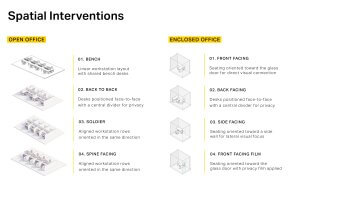
The workstation layouts below illustrate the four desk configurations that were evaluated by six adults with ADHD across both an enclosed private office and an open-plan workspace. While each arrangement maintained the same work tasks, they varied the participants’ relationship to circulation, visibility, and environmental exposure through changes in desk orientation.
Key insights
Enclosure does the heavy lifting
Within the enclosed private office, changing the desk orientation produced little difference in EEG activity across the four workstation layouts. The surrounding enclosure appeared to moderate the influence of desk orientation, suggesting the room itself reduced the cognitive demands associated with monitoring the surrounding environment.
Participants’ perceptions, however, revealed a more nuanced story. While orientation did not meaningfully change neural activity, it did influence how the space was experienced. The side-wall orientation was linked to higher perceived concentration and lower fatigue. In contrast, the back-facing layout, where a glass door left participants more exposed to activity behind them, increased feelings of insecurity by sixty-seven percent, despite participants reporting strong concentration.
Viewed through the lens of Prospect-Refuge Theory, these perceptions are telling. Layouts that better balanced awareness of the surrounding space with reduced exposure from behind were experienced with more comfort; arrangements with a weakened sense of refuge, however, increased feelings of vulnerability. Although the enclosed office appeared to buffer these affects physiologically, participants still recognized subtle differences in comfort and security that aligned with the theory’s central principles.
Open floorplans tell a different story
The open-plan workspace told a different story: without the inherent refuge provided by an enclosed office, subtle changes in desk orientation corresponded with meaningful differences in neural activity associated with cognitive demand.
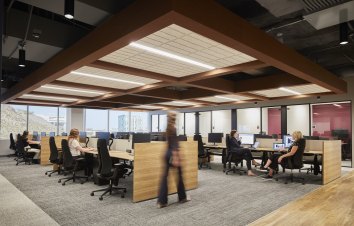
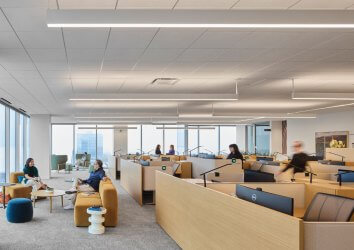
Among the four open floorplan layouts, benching — where participants faced the room with a solid wall behind them — produced the most favorable EEG results, suggesting lower cognitive load than the other workstation configurations. Viewed through the lens of Prospect-Refuge Theory, this arrangement provided both a clear view of the surrounding space and a consistent sense of refuge. These findings suggest that maintaining awareness of the surrounding environment while limiting exposure from behind may help reduce the effort required to sustain attention.
Interestingly, the spine-facing layout revealed a more nuanced finding. By maintaining a solid wall behind the participant while partially blocking the outward view with a privacy screen, this set-up produced the strongest task performance despite offering lower prospect than the benching layout. While exploratory, this finding suggests that the goal may not be maximizing visibility or visual screening, but finding the right balance between environmental awareness and filtering unnecessary visual distractions.
Comfort and cognition can diverge
Across both workplace settings, subjective experience and physiological response did not always move together. In the enclosed office, participants perceived meaningful differences in concentration, fatigue, and security despite little change in EEG activity. In the open office, workstation orientation corresponded with measurable differences in cognitive demand, yet the back-to-back layout was still perceived as one of the strongest performing configurations.
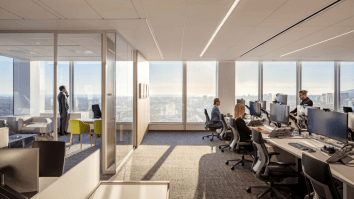
One possible explanation is that individuals with ADHD may interpret heightened mental effort as productive engagement because they are accustomed to working harder to sustain attention. Rather than privileging physiology over perception, the findings highlight the value of considering both objective and subjective measures.
The disconnect is a useful reminder that comfort and cognitive strain don’t always align, and how people feel isn’t always a reliable measure of what a space is asking of their brain.
In the configuration offering the least prospect or refuge — facing a wall with their back exposed — participants did not necessarily rate the experience as stressful. Yet, the physiological data told a different story, revealing elevated cognitive effort, suggesting their brains were working harder to maintain focus even when effort wasn’t consciously registered.
Implications for workplace design
While the findings come from a small pilot study, they point to a design principle worth taking seriously: in open environments where sensory input is harder to control, something as simple as desk orientation can change how much effort it takes to stay focused.
Rather than reconfiguring walls or expanding square footage, researchers altered only the orientation of the desks, a single adjustment that corresponded with a measurable shift in cognitive effort. The result offers organizations a compelling signal for where to direct investment in inclusive design: some of the highest-impact interventions may also be among the most economical.
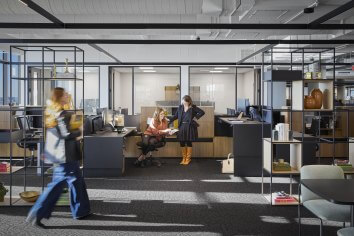
The broader implication is not that every desk requires a wall behind it, but that visibility and backing can be adjusted to fit different needs rather than treated as fixed requirements. Security can be introduced within an open environment without sacrificing the collaboration it was designed to support.
Because no single layout serves every individual, variety itself becomes a deliberate strategy. A strategic variety of desk configurations, focus rooms, and informal breakout spaces that allows people to match their environment to the demands of a given task offers the most optimal outcomes.
The workstation layout findings represent an exploratory analysis conducted with a subset of participants from the broader study. As such, they should be considered hypothesis-generating rather than conclusive, providing an early evidence base to inform future research and workplace design.
Acknowledgements
These findings around workplace layouts have been published in Architecture, a pear-reviewed journal. Please visit the link below to read the full article.
Jinoh Park, Ph.D., Assistant Professor at the University of Arkansas
Michelle Boyoung Huh, Assistant Professor at Virginia Tech
Marjan Miri, Assistant Professor at Drexel University
Samantha Flores, Vice President, Director, Hugo, Corgan
1. Dosen, A.S., Ostwald, M.J. Evidence for prospect-refuge theory: a meta-analysis of the findings of environmental preference research. City Territ Archit 3, 4 (2016). https://doi.org/10.1186/s40410-016-0033-1
The research testing environment was supported by in-kind material contributions from the following:
WRG
BuzziSpace
Finelite