

West Wharf Greenpoint Master Plan
Project Stats
- Location
New York, New York
- Size
7 acres
- Role
Master Planner
Architect
- Market
- Expertise
A mixed-use destination with vibrant public space
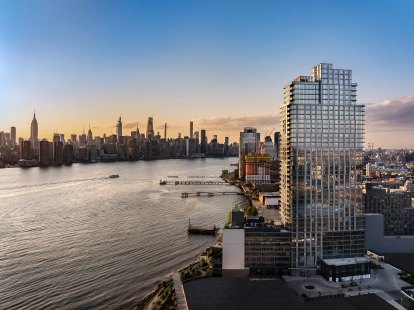
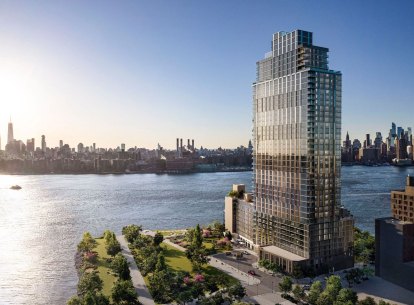
Set along Brooklyn’s growing East River waterfront, the West Wharf Greenpoint initiative transforms a long-underutilized seven-acre site into a mixed-use destination combining a planned 1,000-plus units of housing with new commercial uses and vibrant public spaces. As the master planner for this ambitious project, the team was responsible for ensuring the overall site design met critical public access and storm resiliency goals, and for successfully integrating this large-scale complex into the surrounding neighborhood.
A new era for the north Brooklyn waterfront
Following a seminal 2005 rezoning process, the formerly industrial waterfront neighborhoods of Williamsburg and Greenpoint began a decade-plus-long transformation into some of the New York metro region’s most desirable neighborhoods. The West Wharf site, on a promontory just north of Bushwick Inlet, represented one of the last and largest development opportunities along this waterfront zone with four distinct development parcels offering uninterrupted views of the Manhattan skyline and proximity to a new municipal commuter ferry terminal. The phased project comprises two waterfront high-rise towers, the first of which is now open to residents, and two additional residential structures.
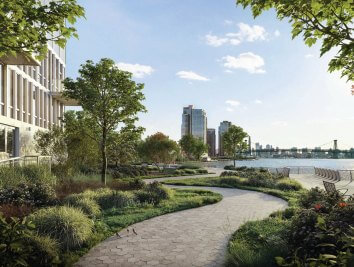
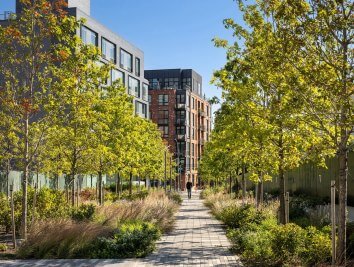
The planning team conceptualized the site as a seamless extension of the existing Greenpoint neighborhood. Key urban design moves focused on effective physical and visual connections to the city street grid and surrounding context. A series of broad, tree-lined passageways extend from West Street, the adjacent thoroughfare, to a new public shore walkway — creating direct public access to the waterfront for the first time in many years and contributing to local officials’ goal of a continuous waterfront esplanade across the district. Additionally, a new beach offers accessible water access via both a ramp and seat steps.
Storm-resilient planning
Building on studies for post-Hurricane Sandy recovery efforts in Manhattan, Brooklyn, Queens, and New Jersey, the West Wharf master plan also addresses flood resiliency considerations. Bermed landscaping means that all residential uses are raised above flood level, and the waterfront open space configuration and planting selections were crafted to mitigate the impact of storm surges. The plan also prioritizes permeable surfaces across the entire seven-acre site, helping safeguard against increasingly heavy rainfall and related weather events. West Wharf offers a prime example of how thoughtful urban design and planning strategies can create value for owners, building residents, and the public alike.