
Longwood University Residence Halls
Project Stats
- Location
Farmville, Virginia
- Size
246,000 SF
- Role
Design Advisor, Design Architect
- Market
- Expertise
Embracing the future, strengthening identity
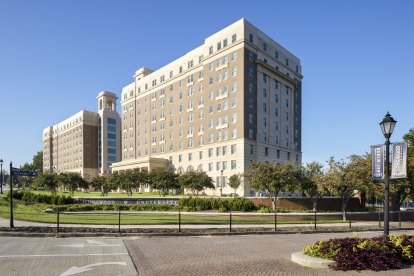
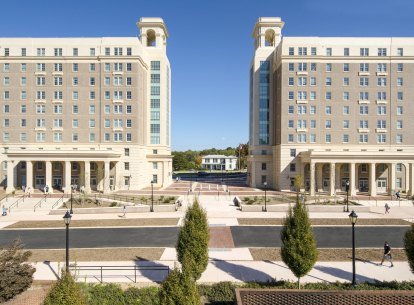
As the first capital project resulting from its 2016 strategic campus master plan, this initiative reimagines two of Longwood University’s most prominent 1970s-era buildings — a pair of 10-story residence halls — with a comprehensive renovation that adds contemporary amenities, increases residential capacity, and better aligns their architectural appearance with Longwood’s established campus fabric.
To create a signature visual presence for the university that is visible for miles in all directions, the design incorporates new cornices, decorative columns and balconies, and a new cupola atop each building. New covered porch elements at ground level facilitate the use of valuable outdoor space. In addition, the design replaced and upgraded all mechanical systems and created a new interior program for both buildings to increase the number of residential units and add significant amenity space, with fixtures and finishes in a material palette that matches the buildings’ new architectural impact.
Unlocking the potential of existing assets
Collaborating with technical experts and local designers alongside university leaders, the project team conceptualized a creative approach for repositioning the two residence halls. Strategically planned and phased to minimize disruption during the academic year, Moss Hall (formerly Frazer Hall) was renovated first, allowing the second tower, Johns Hall (formerly Curry Hall) to remain fully occupied, therefore minimizing the impact on students and limiting the loss of campus housing units during the renovation period.
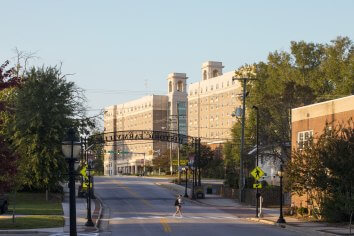
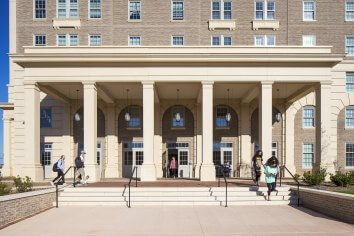
Strategic design decisions reflect a dual focus on Longwood’s broader institutional aspirations as well as the pragmatic requirements of an active university campus. The use of an insulated precast, brick-faced panel façade system allowed the project team to closely match the aesthetics of the surrounding historic fabric while dramatically accelerating construction timelines and meeting Longwood’s goal of having each building renovated during a single academic year. The precast façade panels stack on the foundation and tie back to the existing steel frame, reducing the its structural load and eliminating the need for time-intensive and costly structural upgrades.
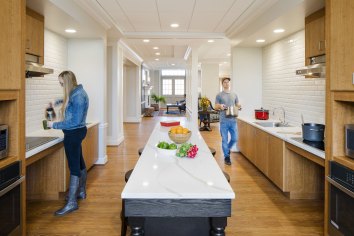
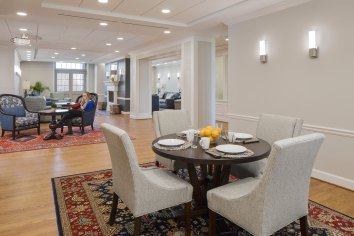
The new halls now accommodate 400 students each with an expanded array of double rooms, double suites, and triple suites in the 246,600-square-foot complex. The reconfigured interiors offer new shared spaces including kitchen and dining areas, study nodes, and flexible lounge and gathering zones of different sizes. The transformation of these residence halls marks a major first step in implementing Longwood University’s master plan and results in a more welcoming gateway onto this rapidly growing institution’s campus.
A new signature presence
This repositioning initiative also considers other key goals from the campus master plan, including an expanded and improved public space. As part of the building renovations, the project team designed significant upgrades to the surrounding landscape and hardscape, including a new public plaza between the two residence halls that establishes a welcoming gateway to the campus and a more harmonious visual connection to the surrounding community — an ideal expression of Longwood University’s vision for building an environment that fuels and supports aspirations for excellence.
This project was completed by Cooper Robertson prior to its acquisition by Corgan in November 2025.