


ATL Aviation Administration Center
Project Stats
- Location
Atlanta, Georgia
- Size
179,000 SF
- Role
Prime
- Market
- Expertise
Architecture
Brand + Graphics
Furniture Strategy
Interior Design
Workplace Consulting
Central and connected
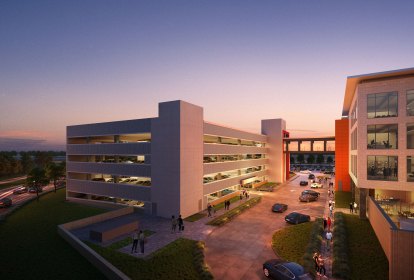
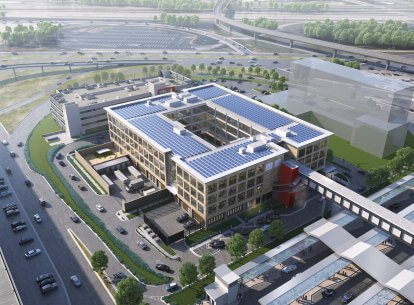
After many decades of the its various departments working from offices scattered throughout the main terminal at Hartsfield-Jackson Atlanta International Airport (ATL) and other airport properties, the Atlanta Department of Aviation (DOA) sought to create a central location for its employees. The ATL Next capital development program gave the department the opportunity to pursue a solution that unified all of its departments under one roof, with room for future growth. The resulting Aviation Administration Center (AAC) is a four-story, 179,000 square-foot facility with a concrete structural frame that facilitates nearly column-free interior floorplates. The beautiful, light-filled office building is wrapped around a central courtyard, prioritizing flexibility and connection for all users.
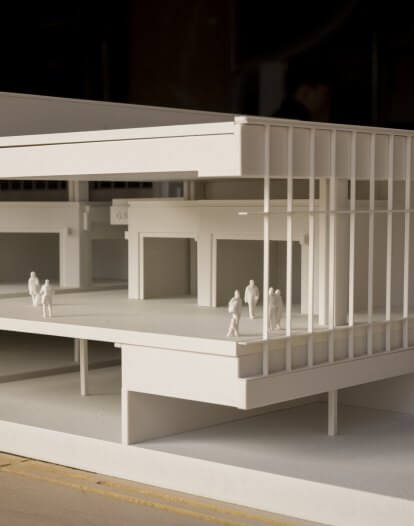
Positioned just west of the airport, it is easily accessible from both the SkyTrain station and staff parking garage via convenient skybridges. The project includes a five-story, 480-car parking garage to the west of the office, with the site configured to allow for the future construction of a hotel tower and conference center.
Designed for team efficiency
With significant site constraints — Interstate 85 to the west and north, the terminal to the east and airport parking to the south— and demanding programming requirements, the design team developed several massing plans before landing on the courtyard model. This large center courtyard floods the workplaces with natural light, ensuring that no work area is more than 60 feet away from daylight and providing scenic views to the social courtyard.
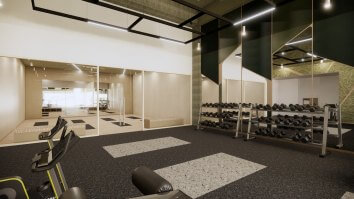
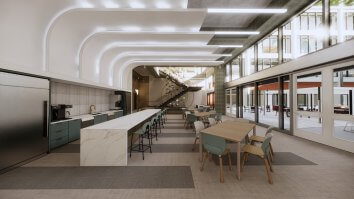
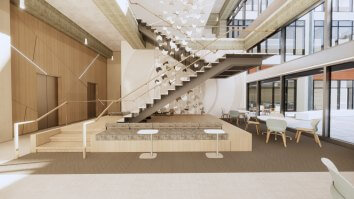
Inside, the first floor contains the Atlanta Airport Police precinct as well as a large multi-purpose meeting center. A large, double-height break area adjoins to the landscaped central courtyard, providing a place for connection and relaxation for employees. Small break rooms and a large fitness center on the first floor round out the amenities. The covered, open-air staff bridge and SkyTrain bridges connect at opposite sides of the third floor, enhancing access and circulation.

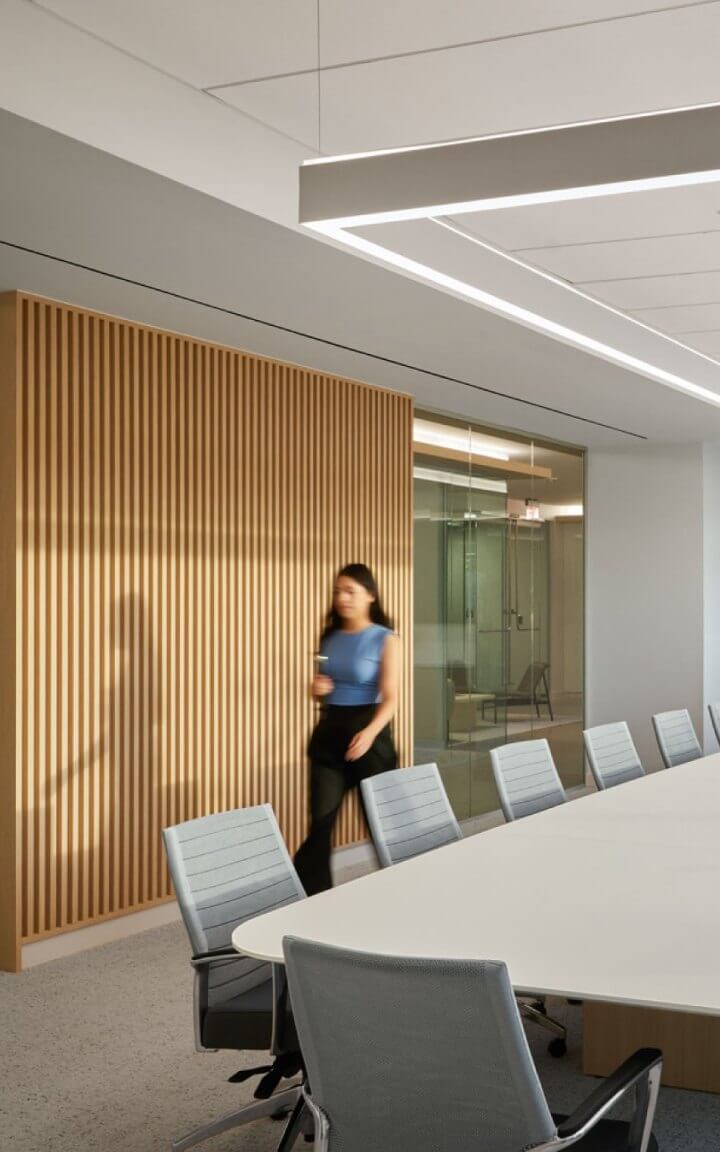
All DOA workspaces occupy the top three floors, with each department grouped together and amenities and support spaces interspersed. In these areas, the design team prioritized connection and efficiency, with a shared neighborhood concept that allows for a smooth transition between different working environments. The flexible workplace is divided into neighborhoods which adapt to the size of each team. During visioning sessions, an emphasis on flexibility resulted in the team incorporating alternative work and meeting spaces near the workstations: open booths, private phone rooms, huddle rooms, and touchdown spaces provide employees with options for collaboration and focus. A variety of conference room sizes and a large training room with an operable partition further enhance the flexibility of the space.

Mission ready
The design concept weaves together two distinct visual narratives: the rotating patterns of aircraft propeller blades and the expansive, radiating trajectories of flight paths from ATL. This concept symbolizes the notion of “propelling into the future,” serving as a celebration of the vital connection and energy that originate from the airport. The AAC lies as the heart of this vibrant movement, serving as its foundational center. The bright red external stairwell tower highlights the central vertical circulation column while nodding to the airport’s brand. Inspired by the hypnotic flow of live flight maps, the monumental stair in the double-height break area features a metal screen featuring an abstract depiction of planes.
The brand strategy was anchored in language that reflects both Atlanta’s cultural identity and the airport’s own ethos — community, purpose, connection, and impact — serving as the foundation for every design decision. Each of the four building levels became a physical expression of these principles, creating a cohesive brand experience throughout the facility.
On level one, the Atlanta community takes center stage, with graphic elements that reference the city’s skyline and landmarks as well as a feature wall of its history displayed in a timeline. Level two highlights the airport’s mission: One Team, united in delivering excellence and connecting its community to the world. This vision comes to life through a mosaic of hundreds of acrylic luggage tags, symbolizing the journeys of travelers as they move across the world. On level three, the airport’s global connectivity is symbolized by an intersecting cable installation, with the letters “ATL” positioned at the core of the connection point. On level four, ATL’s global impact over the years is illustrated through a wooden installation with routed airport codes that highlight the airport’s direct connections across the world. Every material, graphic, and spatial gesture is intentionally aligned with the brand, ensuring the environment is not just functional but a living representation of ATL’s identity.
The gold standard
The AAC was designed to meet LEED Gold standards. The daylight penetration facilitated by the courtyard means that less electricity is used to light the offices. Water efficient features, locally sourced materials, and optimized energy use all decrease the facility’s carbon footprint. Additionally, photovoltaic panels on the rooftop will generate electricity to be used by the AAC. The parking garage is ParkSmart certified and has 24 electric vehicle (EV) charging stations, with 82 EV charging capable stations.