The Case for Art at Work
Findings compiled by Hugo, Corgan’s research and innovation team, make the case that art in the workplace can be a measurable driver of well-being, creativity, and organizational identity.
When workplace design budgets come under pressure, art is often the first item to be scaled back. Art is treated as a decoration, a finishing touch applied after the other decisions about layout, furniture, and technology have already been made. But new findings suggest that art should not be an afterthought. Art functions instead as a key component that shapes how people feel, think, and perform at work, one that belongs alongside any other strategic investment.
The research was conducted as a response from a request from a nonprofit arts organization. Hugo scanned the existing research marketplace and summarized what is already known about the impact that art has within organizational workplaces. What emerged was a layered picture — one that connects the presence of art in the workplace to measurable outcomes in well-being, creativity, and employee engagement, offering a clear framework for how designers and facility leaders can put these findings into practice.
Employee well-being linked to organizational results
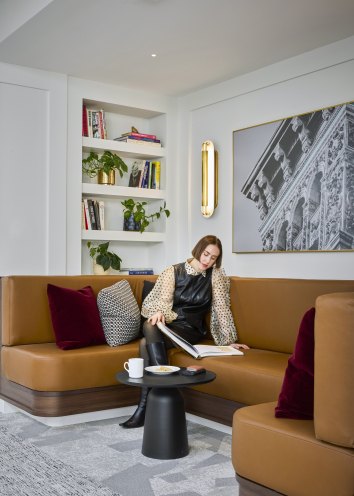
Workplace art can contribute to organizational performance. Research has linked employee wellbeing with outcomes such as improved engagement, productivity, and organizational success1. In one study, 78% of respondents believed that workplace art played a significant role in reducing stress2. Another study involving 2,000 office workers found that employees in environments enriched with plants, imagery, and artwork were 17% more productive than those working in bare, minimal spaces3,4.
Art can also help create environments that strengthen connection and give employees a greater sense of agency. When employees feel supported and inspired by their surroundings, they may be better equipped to contribute to ideas, collaborate with others, and advance shared organizational goals. In this way, individual benefits, such as reduced stress, increased motivation, and stronger connections, can translate into collective outcomes5,6.
Integrating art into the workplace is therefore an investment in both people and organizational performance. When selected and implemented intentionally, art can support employee wellbeing while contributing to a more engaged, productive, and connected workplace.
Creativity inspires productivity
While people might already understand that art eases stress and supports personal well-being, findings also point to less obvious, but equally important, benefits. Interaction with art reveals a strong association between enhanced creativity and cognitive processes7. Employees who engage with art show greater open-mindedness and a stronger willingness to approach problems from unfamiliar angles.
Beyond employee versatility, the stimulation of creativity through regular exposure to artwork can lead to innovative ideas with more productive, successful outcomes8. This effect compounds at the organizational level. Even minimal interaction or engagement with art was linked to measurable gains in idea generation and problem-solving agility, suggesting that creativity is a scalable trait9. Furthermore, the presence of art has the potential to instill a sense of curiosity, wonder, and fascination within us — both precursors to creativity and productivity10.
These findings resonate today more than ever with the growth of artificial intelligence across industries. As automation increases, creativity is recognized as a distinctly human capability — one that differentiates a workforce rather than merely supporting output.
Curated collections support variety of needs
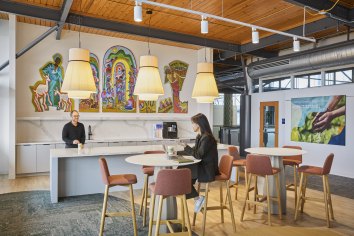
Thoughtfully selected artwork and collections can play a meaningful, purposeful role in shaping a healthy, productive workplace. Existing studies have demonstrated that employees are likely to spend more time at work if it is an aesthetically pleasing environment11,6 and artwork plays a significant role by instilling a sense of place and belonging10.
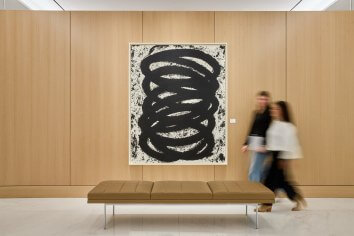
Nature-based imagery has been shown to offer many of the same psychological benefits as natural environments, including stress reduction, lower anxiety levels, and improved mood, making it an increasingly popular choice in workplace environments and healthcare facilities12,13. Additionally, abstract art offers a different but equally valuable presence; rather than depicting reality directly, color, form, and expressive forms encourage reflection, giving employees room to pause, reflect, and engage in open-ended thinking that inspires creativity and innovation14. Abstract art comprised of lower visual complexity, contrast, and color intensity is most palatable to the human eye15. Therefore, the more comprehendible the piece of abstract art, the more effectively it supports emotional appraisal.
Beyond the visual and psychological benefits of the artwork itself, the findings revealed insights that the selection process itself presents opportunities to strengthen ties with the community. Engaging local artists in the curation process or adding their works to the collection allows a company to support the local economy, offer cultural awareness, and offer a broader commitment to diversity and inclusion16.
Art placement and duration matters
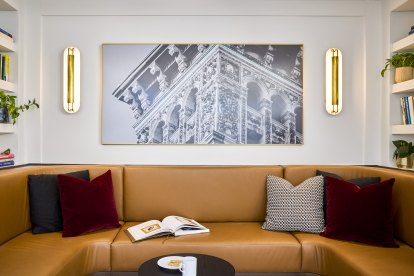
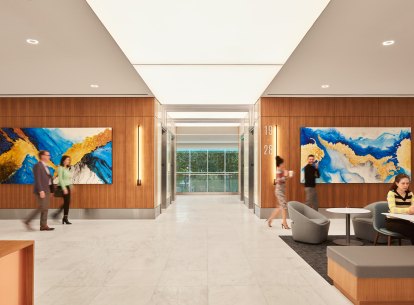
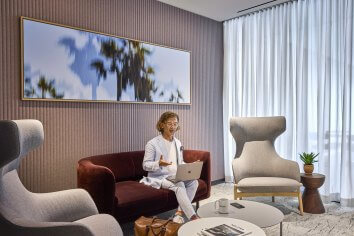
The research also points to practical variables that designers and facility leaders can act on directly: placement, duration, and the design intent of the space. Findings favor placement in communal, high-traffic areas — such as break rooms, conference rooms, and reception zones — where art can offer a genuine, restorative pause or generate conversation throughout the day rather than fade into the background17. Communal areas also reach larger numbers of people and a wider range of individuals compared to specific workstation floors.
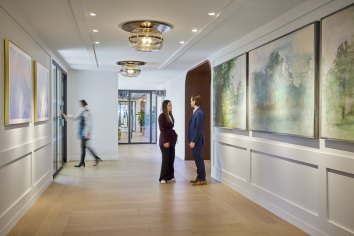
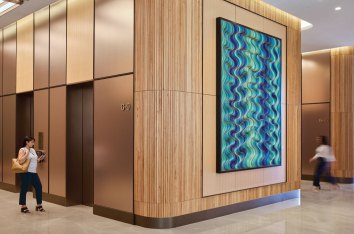
Beyond placement, how long employees spend with a piece of art matters. As little as one to five minutes of focused exposure to art reveals reduced anxiety levels and increased dopamine18,19,20. Repeated exposure to art was also shown to have a significant impact on cognitive functioning, mood, and depression21. For neurodiverse employees, including those with ADHD, a greater degree of stimulation, visual complexity, and rotating collections can further support their needs22.
Art as a strategy, not a sentiment
The takeaway for companies isn’t that they need an unlimited budget; rather, organizations should deliberately curate and create an art program for their workplace environment. The findings consistently point to the same ideas: art works best when chosen with a specific population and purpose in mind. Improving wellbeing, sparking conversation, and reinforcing a sense of identity are just more examples of what art can do in the workplace, resulting in increased productivity and successful end results for organizations. Research suggests that the real cost isn’t spending too much on art — it’s spending nothing at all.
Source List
Kinne, A. (2024). 12 Common Workplace Challenges and Solutions to Overcome Them. https://www.workhuman.com/blog/workplace-challenges/
Higginbottom. (2016). The Impact of Art in the Workplace. Forbes. https://www.forbes.com/sites/karenhigginbottom/2016/05/01/the-impact-of… 13 workplace/#3e43736165a3
Nieuwenhuis, M., Knight, C., Postmes, T., & Haslam, S. A. (2014). The relative benefits of green versus lean office space: Three field experiments. Journal of Experimental Psychology Applied, 20(3), 199–214. https://doi.org/10.1037/xap0000024
Ralf, O. (2024). The Psychological Effects of Art in the Modern Workplace. https:// 15 www.acrylicize.com/perspectives/the- psychological-effects-of-art-in-the-modern- workplace
Irawati, L., Khaeruman, & Farradia, Y. (2021). International Journal of Educational Research & Social Sciences. International Journal of Educational Research & Social Sciences, 2(4). https://doi.org/10.51601/ijersc
Bromels, R. (2016). Employee Engagement Workbook Series: Corporate Arts Challenges. Americans for the Arts.
Ho, A. (2020). Art at work: Measuring its impact and value. One Workplace. https://www.oneworkplace.com/blog/art at-work-measuring-its-impact-and-value
Meltzer, C. (2022). What Matters? Empowering Non-Artists to Use Arts-Based Learning: Leading Developmental Projects in Schools and Workplaces. Organizational Aesthetics, 11(1), 98–119.
Bara, I., Ramsey, R., & Cross, E. S. (2024). Art Knowledge Training Shapes Understanding, Inspires Creativity and Stimulates Thinking.
Myers, M. (2020). Visual Art as a restorative, place-based biophilic coping mechanism in the workplace: A Case Study. Kent State University.
Barton, G., & Le, A. H. (2023). The importance of aesthetics in workplace environments: An investigation into employees’ satisfaction, feelings of safety and comfort in a university. Facilities, 41(13/14), 957–969. https://doi.org/10.1108/F-03-2023-0016
Heiser, C. (2017). How the simple act of nature helps you de-stress. NBC. https://www.nbcnews.com/better/pop culture/how-nature-can-solve-life-s-most-challenging-problems-ncna749361
Robbins, J. (2020). How immersing yourself in nature benefits your health. PBS. https://www.pbs.org/newshour/health/how-immersing-yourself-in-nature-benefits-your-health
Supanakorn, W., & Phaetlakfa, K. (2023). The Way to Create added Value through the Process of Art, Abstract Painting Case Study of Phakhaoma.
Tinio, P. P. L., & Gartus, A. (2018). Characterizing the emotional response to art beyond pleasure: Correspondence between the emotional characteristics of artworks and viewers’ emotional responses. In Progress in Brain Research (pp. 319–342). Elsevier. https://doi.org/10.1016/bs.pbr.2018.03.005
Edwards, M. (2021). Case Study: Promoting Diversity, Equity, and Inclusion Through Art. American College of Radiology. https://www.acr.org/Practice-Management-Quality-Informatics/Imaging-3/C… Engagement/Promoting-Diversity-Equity-and-Inclusion
Leitz. (2023, September 27). Do the Aesthetics of Your Workplace Affect Productivity? https://www.leitz.com/en gb/blog/leitz/workleitzbalance/do-the-aesthetics-of-your-workplace-affect-productivity/
Delgado, C. (2022). How Does Viewing Artwork Online Benefit Your Mental Health? Discover. https://www.discovermagazine.com/mind/how-does-viewing-artwork-online-benefit-your-mental-health
Jagoo, K. (2022). Looking at Art Online Has a Similar Effect on Mental Health as Looking at Physical Art. https://www.verywellmind.com/looking-at-art-online-has-a-similar-effect-on-mental-health-as-looking-at physical-art-6361687
Mostajeran, F., Krzikawski, J., Steinicke, F., & Kühn, S. (2021). Effects of exposure to immersive videos and photo slideshows of forest and urban environments. Scientific Reports, 11(1). https://doi.org/10.1038/s41598-021 83277-y
Roswiyani, R., Kwakkenbos, L., Spijker, J., & Witteman, C. L. M. (2019). The Effectiveness of Combining Visual Art Activities and Physical Exercise for Older Adults on Well-Being or Quality of Life and Mood: A Scoping Review. Journal of Applied Gerontology, 38(12), 1784–1804. https://doi.org/10.1177/0733464817743332
Motta, M. R. (2021). Bara, Ionela and Ramsey, Richard and Cross, Emily S., Art Knowledge Training Shapes Understanding, Inspires Creativity and Stimulates Thinking. Available at SSRN: https://ssrn.com/abstract=4693410 or http://dx.doi.org/10.2139/ssrn.4693410 [University of Sao Paulo]. https://www.teses.usp.br/teses/disponiveis/59/59134/tde-10012022-093717/en.php