
Rethinking Schools for Teachers with Disabilities
The Hidden Gap in School Design
Educators operate in learning environments often designed with students as the primary focus, while their own needs remain underrecognized. At the same time, increasing professional demands contribute to rising stress, burnout, and retention challenges. Nearly one in eight teachers experiences one or more disabilities, including learning differences, chronic illnesses, physical disabilities, or visual impairments, that shape how they engage with the built environment.
While inclusive design in education has traditionally focused on students, this study addressed a critical gap by centering educators as primary users of learning environments whose needs are often underrepresented in design decision-making.
Supported by the American Society of Interior Designers Foundation, this research integrated qualitative insights from educators with embodied simulation, physiological measurements, behavioral observations, and self-reported data to understand how additional physical or sensory limitations shape task demands, emotional responses, and perceived capabilities.
Conducted in partnership with Thornton Elementary School and Arlington Independent School District, findings were translated into actionable, inclusive design strategies – engaging educators and other stakeholders throughout from insight gathering to collaborative workshops.
METHODOLOGY
Where Empathy Meets Evidence
Understanding how educators with disabilities experience the built environment requires moving beyond conventional evaluation methods — connecting lived experience with measurable impact. This study adopted a mixed-methods approach, beginning with a focused literature review to identify key gaps and inform the research methodology.
Building on this foundation, the research progressed through sequential phases — outreach through surveys and interviews, simulation, analysis, and design application— each designed to capture and connect different dimensions of educator experience.
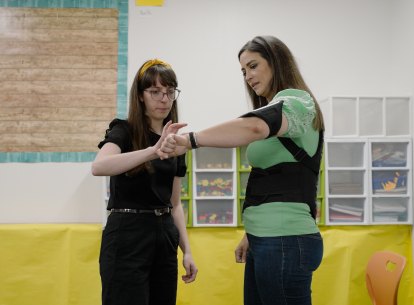
Surveys and interviews documented the lived realities of current and former teachers with disabilities. While on-site simulations using the GERT suit and other simulation tools introduced varying physical and sensory conditions to educators in real educational settings.
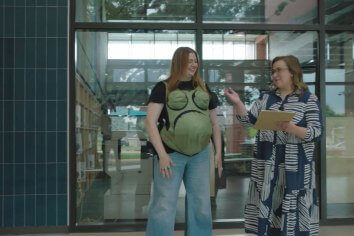
Behavioral observation, wearable-based measures, and self-reported data collected through simulation revealed how these conditions influenced effort, stress, cognitive load, and interaction with space.
By integrating qualitative insights with experiential and physiological data, the study generated a robust, evidence-based understanding of environmental performance. This triangulated approach strengthened validity while supporting actionable design strategies.
GROUNDING RESEARCH IN LIVED REALITIES
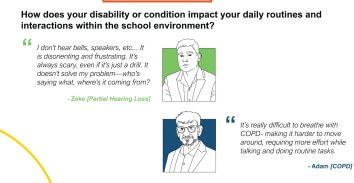
To better understand how educators with disabilities navigate school environments, the study drew directly from their lived experiences—capturing challenges that are often difficult to simulate or observe.
Educators were engaged through both moderated and unmoderated formats, leveraging outreach through school networks and remote testing platforms to capture a range of perspectives. Across 41 interviews and 77 surveys, participants shared how physical, sensory, cognitive, and organizational factors shape their work, alongside the strategies they use to adapt.
Through these conversations, key dimensions emerged that are difficult to replicate—including cumulative fatigue, anticipatory stress, and the cognitive effort required to navigate spaces primarily designed for students. These insights revealed systemic barriers and the often-invisible labor required to sustain performance over time, grounding the research in a real-world context and reinforcing the study’s broader findings.
SIMULATING IN REAL-WORLD ENVIRONMENTS
To examine how environmental conditions shape educators' experiences, simulated scenarios were implemented through controlled, on-site experimental activities. Using embodied empathy tools, like the GERT suit, structured classroom tasks were carried out within educational settings, introducing a range of physical and sensory constraints to test real-time responses.
The study captured physiological, self-reported, and observational data, revealing how spatial and environmental factors directly influenced task demands, cognitive effort, emotional response, and interaction with space—extending and validating patterns identified through lived experience.
Garmin-based physiological data—including GPS, heart rate, and movement (speed and cadence),was analyzed to understand real-time responses during simulated tasks.
Explore the Garmin analysis and data more in depth here.
Designing for the Full Spectrum
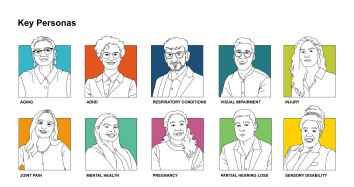
Findings from interviews and simulation experiments were translated into ten personas, capturing a range of educator experiences across physical, sensory, and cognitive conditions. These personas formed the foundation for collaborative workshops, where educators, designers, and stakeholders engaged with the research to test, interpret, and apply insights in real-world scenarios.
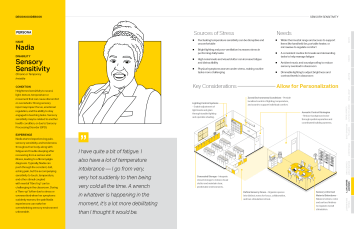
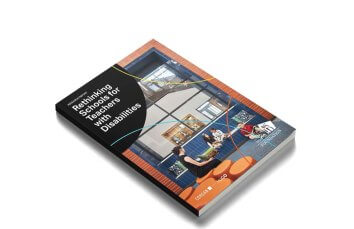
Through this process, research was transformed from evidence into action—shaping a set of design strategies that respond to both individual needs and shared spatial realities. The resulting guidebook provides a practical framework for applying inclusive design across scales, supporting environments that reduce strain, enhance capability, and sustain educator performance over time.
Designing for Impact at Scale
Design operates at multiple scales, but its impact is experienced in moments. These 5 implications translate research into actionable strategies that improve performance, adaptability, and well-being for educators in learning environments.
Create environments that reduce physical demands and support sustained movement throughout the day. This includes providing varied work zones that support upright, seated, and assisted postures; removing barriers to movement; and organizing tools and materials to reduce unnecessary steps, reaches, or lifts. The goal is to extend physical capacity without compromising comfort or professional presence.
Enable dynamic interaction with the environment by allowing teachers to adjust layout, teaching tools, and work surfaces in response to physical needs and pedagogical shifts. Flexible systems - such as reconfigurable zones, multi-purpose furnishings, and personalized equipment - help accommodate the diverse and evolving ways educators engage with their classrooms.
Support focus and decision-making by streamlining classroom environments. Use simple spatial hierarchies, intuitive organization, and calming sensory design to minimize distractions. Layer in thoughtful acoustics, adjustable environmental elements, wayfinding cues, and clear zones for quiet vs. active tasks to help teachers maintain focus and reduce mental strain during their daily teaching routine.
Design not just to meet minimum accessibility standards, but to create inclusive environments that support full range of user diversity - making every user feel considered, not accommodated. This includes providing universally usable teaching environments, equitable access to storage and tools, multisensory support for vision, hearing, and movement. Designing for a wide range of physical, sensory, and cognitive needs from the outset ensures all educators can thrive without extra effort.
Prioritize features that help preserve energy, promote recovery, and support emotional regulation throughout the school day. This can include both operational and design strategies such as micro-breaks policy, layered support through shared teaching roles or assistance, space to rest, focus, and collaborate. These strategies reinforce educator capacity and care in emotionally demanding settings.
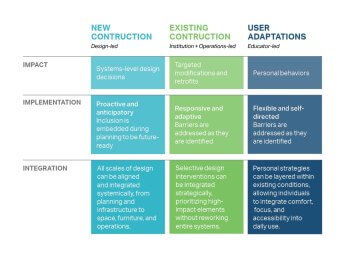
Impact is not defined by a single decision—it is built over time through layered, coordinated actions. The most effective environments are those that evolve, responding to changing needs while maintaining clarity and intent.
By aligning design, operations, and individual use, these strategies extend beyond isolated interventions to shape environments that are more resilient, adaptable, and capable of performing under real-world demands.
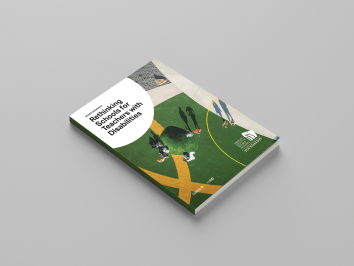
Design Guidebook
Explore the design guidelines to learn actionable strategies for creating inclusive learning environments that support educators with disabilities.
Acknowledgment
This research was supported by the American Society of Interior Designers Foundation Transform Grant, advancing a broader effort to understand how design can better respond to diverse user needs. We acknowledge the collaboration of Thornton Elementary School and the Arlington Independent School District, whose partnership enabled this work to be grounded in real learning environments. We also recognize the educators who contributed their time and perspectives, informing the research and its translation into design strategies.
Meet the Research Team
Melissa Hoelting, Assoc. AIA, ASID Practitioner, WELL AP, Senior Associate, and Assistant Director of Hugo
Chloe Hosid Sloan, Assoc. AIA, M.Sc., Senior Associate and Education Design Researcher
Yashaswini Karagaiah, Assoc. AIA, WELL AP, LEED Green Associate, Experiential Design Researcher III
Kevin Sloan, Senior Design Researcher
Michael Steiner, AIA, LEED BD+C, WELL AP, Vice President and Senior Project Manager
Beverly Fornof, AIA, Education Associate Principal
Sangeetha Karthik, AIA, RID, LEED AP, Education Principal
Alyssa Oates, Interior Design Project Specialist II
Junling Zhuang, Design Researcher