

Retail is Not Dead — It’s Evolving
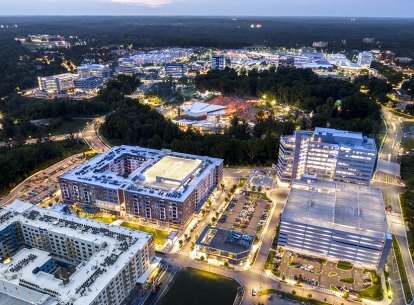
Across three decades, the firm has helped communities reimagine distressed retail as the catalyst for complete neighborhoods. From early work reviving Columbia Town Center to today's planning in Chesapeake and Riverton, we've learned a simple truth: when you treat retail as an activator of public life — not an isolated box — main streets come back, housing follows, and civic pride returns.
The "dead mall" as a downtown seed
COLUMBIA TOWN CENTER
Years ago, Columbia, Maryland, faced a familiar dilemma: a fading mall, acres of asphalt, and a downtown that never quite clicked. Our role was to flip the script, shifting from single-use retail to a mixed-use, walkable framework organized by streets and squares. The move wasn't about saving every storefront; it was about curating the right ground-floor uses along human-scaled blocks, threading in housing and offices, and elevating parks and waterfront. Retail became the front porch of civic life — small bays, flexible depths, and corner doors that invited pop-ups and local entrepreneurs. That DNA — fine-grained parcels, active edges, and a connected public realm — remains our baseline for retail-anchored placemaking. When the plan is fully realized, there will be over 6,200 new residential units (including 900 affordable units), 4.3 million square feet of office space, 1.25 million square feet of retail space, 640 hotel rooms, new convention space, and additional cultural and civic space and amenities.
Re-centering a district around everyday life
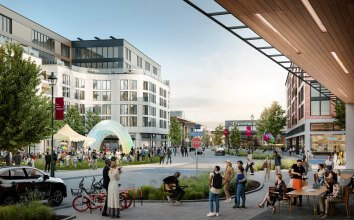
In Greenbrier, we're applying the next generation of the same toolkit. Rather than doubling down on big boxes, the plan recomposes overscaled blocks into a legible street grid with safe crossings, mid-block paths, and tree-lined "complete streets." We position retail where it does the most city-making: on corner lots, framing small plazas, and at transit-ready intersections. Upper floors add missing middle housing and workplaces; stormwater landscapes do double duty as parks. The result is not simply a shopping district with some housing, it's a mixed-use neighborhood where retail naturally succeeds because people live, work, and linger there.
Main-street energy, riverfront setting
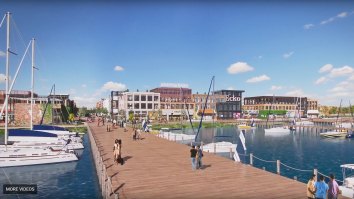
Riverton offers a different canvas: a historic fabric and a powerful riverfront. Here, the goal is to extend the charm of Main Street to the water's edge — knitting together storefronts, small-format food and beverage, maker spaces, and community services with walkable blocks and memorable public rooms. We prioritize first-floor transparency, porches and stoops, and corner "hinge" spaces that can flip between retail, cultural uses, and community events. With thoughtful parking management — shared lots, on-street supply, and right-sized curb access — retail remains visible and viable without overwhelming the public realm.
What we’ve learned
From a dying mall in Columbia to district-scale work in Greenbrier and a river-town main street in Riverton, the throughline is clear: retail thrives when it is invited to do what it does best — welcome people, animate the ground floor, and spark everyday encounters. Build a city for life first, and the shops will follow.
Strong blocks, short walks, and shade create the foot traffic retailers can't buy with marketing.
Fewer, better bays beat long empty runs. Depth, servicing, and flexible floorplates matter.
Markets, festivals, and daily rituals in plazas and greens turn "shopping trips" into community time.
Residents above shops keep lights on after 5 p.m.—and stabilize local businesses through seasons.
Buildings and blocks must evolve as tenants and technologies shift.