




No Gas, All Breakers — All-Electric Terminals and the Future of Airports
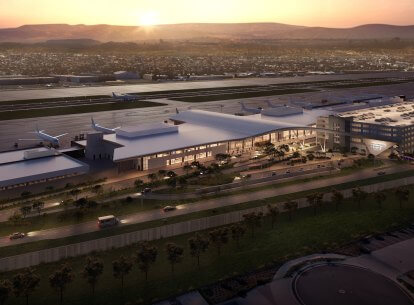
Two of the first all-electric airport terminals in the United States — Terminal C at the San Antonio International Airport (SAT) and the replacement passenger terminal at Hollywood Burbank Airport (BUR) — are under construction. As the industry continues to look for innovative ways to decarbonize its operations, all electric facilities are emerging as a path forward that can benefit airports, passengers, and the environment.
The only way out is through electrification
Simply put, the only route to true decarbonization for any building is by going all-electric. Any time fossil fuels are used, greenhouse gas (GHG) emissions are produced by a facility’s operations. Since commercial and residential buildings represent nearly a third of emissions in the United States, reducing emissions — including via electrification — is top of mind when designing the built environment. Developers and owners across all markets are increasingly opting to build all-electric facilities in preparation for a cleaner electricity grid that reduces reliance on fossil fuels.
The trend toward electrification is making its way into the aviation building sector. Two of Corgan’s recent projects — the replacement terminal at Hollywood Burbank International Airport and a new terminal at San Antonio International Airport — are among the first fully electric airport facilities in the U.S. Together, they reflect the aviation industry’s evolving priorities for decarbonization and demonstrate that all-electric airport facilities are both feasible and increasingly relevant.
External forces driving change
Given the environmental impact of buildings that use conventional gas systems for heating or cooking, many states have introduced policies requiring new construction to meet specific emissions standards or offering tax credits to retrofit existing buildings with renewable energy systems. New York has already passed legislation banning the use of natural gas and other fossil fuels in new buildings by 2029. Combined with the 300% increase in renewable energy generation over the past 20 years, electrification has the potential to significantly reduce national greenhouse gas emissions.
While there are not currently any guidelines that require new aviation facilities to be all-electric, there are programs that encourage decarbonization across the aviation industry through both social and financial incentives:
- In 2009, Airports Council International (ACI) Europe launched Airport Carbon Accreditation (ACA), a seven-level framework to encourage airports to assess and reduce their carbon emissions. Since then, the program spread to other regions and today, more than 600 airports are accredited to at least level one.
- Airlines have made commitments to sustainable operations: Represented by the International Air Transport Association (IATA), more than 360 airlines have committed to achieving net-zero carbon emissions by 2050.
- In the U.S., a number of federal funding programs for airport improvements target projects that make energy efficient or emissions reducing upgrades, including the Airport Improvement Program (AIP), Passenger Facility Charge (PFC), and Voluntary Airport Low Emissions (VALE) programs. In the absence of policy dictating specific requirements, pressure from within the industry is pushing sustainability initiatives forward.
Why airports choose electric
The benefits of an all-electric airport include reduced construction costs, enhanced self-sufficiency and improved public image, making the move towards electrification both practical and positive for the environment. Since all-electric facilities do not require any natural gas, airports save significantly on costs associated with both adding and maintaining natural gas lines. All-electric facilities can also implement on-site power generation like solar or wind, to increase their self-sufficiency and power redundancy.
A 2025 study published in Tourism and Hospitality Research indicates that an airport’s reputation can be positively impacted by its sustainable design and practices, leading to greater trust and loyalty from passengers. As the industry continues to look for ways to both reduce its carbon footprint and future-proof its facilities, we expect all-electric terminals and airports to grow in popularity in the coming years, just as we have seen with other building types.
Indoor pollution is also key to the sustainability discussion, as gas and propane stoves are a major contributor to poor indoor air quality. Gas stoves emit nitrogen dioxide, which has been linked to asthma, lung cancer, and obstructive pulmonary disease, among other conditions.. So, in addition to their sustainability benefits, all-electric airports can be healthier for concessions workers.
Strategies for sustainability
Though Corgan’s all-electric airport projects at Hollywood Burbank and San Antonio differ in location and performance goals — with one pursuing LEED Gold certification and the other prioritizing operational efficiency — both illustrate what it takes to deliver an all-electric airport terminal. Across building types, the most persistent challenges to electrification are building heating, hot water generation, and cooking. In each case, Corgan’s design team worked in-step with engineering consultants at Syska Hennesy Group and coordinated with airport stakeholders, maintenance and operations staff, and local utility companies to develop practical solutions. The result offers a useful look at how all-electric strategies can be applied in aviation facilities.
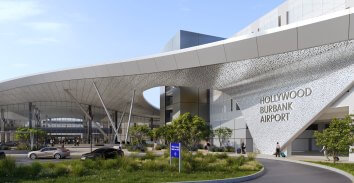
While both Burbank and San Antonio airports are in warm climates, the teams still had to develop plans to heat the terminals without relying on natural gas. At Burbank, heating is provided through a straightforward all-electric approach: air-to-water heat pumps (AWHPs) harvest heat from ambient air to produce heating hot water for use within the building.
In California, the 2025 update to the state’s energy code does not ban the use of natural gas in new construction, but it does require that commercial kitchens be “electric-ready” for a future transition and encourages the use of cleaner heat sources. Because of this, the team designed electrical service and exhaust infrastructure for each vendor to support induction cooking and all-electric kitchens. These strategies eliminate on-site fossil fuel combustion for space heating, water heating, and cooking, while maintaining flexibility for airport operations and tenant needs.
The proposed, all-electric model for the new terminal at Burbank shows a 7.7% reduction in energy costs, which is an accepted substitution for energy use. Lighting costs (28% of energy use) are reduced by using largely LED-based lighting design and aggressive daylighting controls. By adding a 750 kW array of photovoltaic panels, the energy cost is reduced an additional 17% from the proposed model. The airport is also committed to 100% electric ground support equipment (eGSE), including tarmac vehicles such as tugs and other airline equipment.
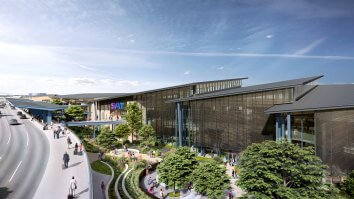
At San Antonio airport, the team’s biggest worry was the concessions program and eliminating natural gas from the airport kitchens. When the prospect of pursuing an all-electric design was introduced, the client was concerned that it would constrain the concessions program by limiting which restaurants could operate sucessfully. (Certain restaurants – like those that require an open flame or very high heat – may not work as well with electric alternatives.)
The team pointed to existing typologies, like food courts and shopping malls, that host a range of restaurants without gas, demonstrating the feasibility of running a robust concessions program in an all-electric facility. The kitchens will include dedicated electrical infrastructure designed to support 100% electrification of cooking appliances. Both 480V, 3-phase and 208V, 3-phase power are made available to tenants and “all-electric” will be included in the concession program for vendors.
As part of the Termincal C project, the client opted to expand its central utility plant. This strategy provides both the necessary cooling capacity and incorporates heat recovery chillers (HRCs) that capture thermal energy from the chilled water system and shift it into the heating system, reducing reliance on cooling tower heat rejection. Waste heat from all of the airport’s terminals chilled water is recovered in a 1 million-gallon thermal energy storage (TES) tank and used to serve Terminal C heating loads, allowing the system to use energy more efficiently and reduce unnecessary heat rejection.
Other sustainable strategies at San Antonio include a mass timber roof, efficient LED lighting and glazing that reduces heat gain while maximizing daylighting. The mass timber roof offers a nearly 30% reduction in embodied carbon emission compared to the alternative of the more conventional steel beams and composite metal deck. The team also designed the airport to accommodate future installation and use of PV panels to generate electricity. Overall, compared with the existing terminals, the new building is projected to consume less power per square foot due to more efficient equipment.
Challenges of electrification
While the Burbank and San Antonio airports demonstrate that all-electric terminals are achievable, they also benefited from favorable conditions: both were new-build facilities in warm climates, and both had project teams aligned around the goals and tradeoffs of electrification. As more airports shift toward all-electric operations, they may encounter more challenging constraints, primarily involving heating and power availability.
Heating any building in a colder climate is much more energy intensive than for those in warmer climates, and natural gas is the typical option, with 73% of commercial buildings using gas heating. Adoption of electric heating technologies like air source heat pumps (ASHPs) is slower in colder climates, and these airports will require a holistic strategy to heat their facilities without relying on fossil fuels. However, as technology evolves (as it always does!), electric solutions are more robust and those cold-climate airports can take better advantage of the combination of electric and renewables, like geothermal or solar water heating, to meet their needs.
The electrification of both Burbank and San Antonio was enabled by robust electric grids that deliver sufficient energy to power these large facilities. To support the increased electricity use at Burbank, the airport was planning the construction of a dedicated substation. For SAT, the municipal electricity supplier was already upgrading the system to provide better redundancy and higher capacity. While this will not be the case for every airport, project teams can work closely with local officials and utility companies to establish a plan for increasing power availability, if needed.
Design-ready for decarbonization
The terminals of tomorrow are all-electric facilities — not as a mechanical design decision, but a long-term decarbonization strategy. As the electric grid moves toward renewable sources and more airports generate energy on site, these facilities will be ready for true decarbonization. Success of these projects depends on addressing the biggest electrification challenges — heating, cooling, hot water, and cooking — early in the planning process and coordinating closely with airport operators, maintenance teams, concessionaires, and utility providers. Corgan’s projects at Burbank and San Antonio prove that all-electric terminals are achievable while underscoring that the most effective solutions are those tailored to each airport’s operational needs, infrastructure constraints, and long-term sustainability goals.