

Aviation & Transportation Roundtable: From Global Hubs to Gateways
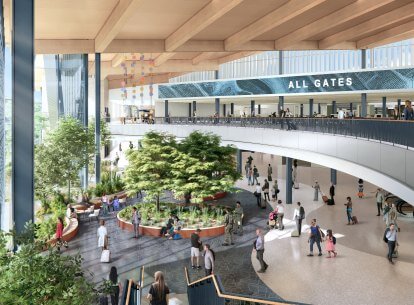
Regional airports are an unsung but critical piece of aviation infrastructure. Whether it is getting people home for the holidays or facilitating life-saving medicine runs, they keep their communities connected. Airport designers Elizabeth Davies, Brian Albers, and Ross Payton discuss what makes regional airport projects unique, what we learn from them, and what our team brings to the table.
WHAT DRAWS YOU TO A REGIONAL AIRPORT PROJECT?
Ross Payton: Regional airport projects give us a chance to create something that is especially connected to the community it serves. Corgan works on everything from single-gate facilities to the world’s busiest airports — we do it all because we love aviation. But at a regional airport, that sense of place and connection can be especially personal and visible. Pago Pago International Airport is the gateway that connects American Samoa to the rest of the world. This project is very personal to every individual who calls American Samoa home — it is central to welcoming loved one home or wishing them well on their journeys. Being a part of something so culturally significant is exactly what draws me to regional airport projects.
Elizabeth Davies: Having worked on all types of projects, from larger hubs to regional airports, I’ve found that working at this scale gives you more face time with the client and decision makers. You get to know them beyond just the project and develop a more personal understanding of what’s important to them. And it’s not just about getting to know the people that run the airport, you also gain a deeper understanding of the city itself, what drives its culture, and what matters to the community. Our clients are closely connected to what their communities want and need, which allows our work to be more thoughtful and responsive, too.
Our clients are closely connected to what their communities want and need, which allows our work to be more thoughtful and responsive, too.
Brian Albers: The sense of a true partnership with the client is especially felt at the regional level, and that makes the decision making process easier and faster. From our side, they're great opportunities because we get to support them from beginning to end. That continuity leads to stronger service and results for clients, communities and passengers. And, on a personal level, a lot of us come from small towns or rural areas, so we know the value these facilities have in the community. Our expansion at Charleston International Airport (CHS) is a prime example of a regional airport that serves both as a launch point to the rest of the world for Lowcountry residents and as the front door to the city’s well known tourism attractions.
DO WE APPROACH REGIONAL AIRPORT PROJECTS DIFFERENTLY THAN HUBS?
Brian: Of course, the scale is smaller, but the impact is almost bigger at a regional facility. Funding streams for aviation projects are based on the number of annual passengers, so for a smaller airport, they might only get one chance at a large capital improvement or expansion every 30 or 40 years. We are often there from the beginning of the project to the end, which is rarer at a larger airport. To get to be the advisor for that type of project is something we take seriously, since we know that these projects will have a long-lasting impact on the community.
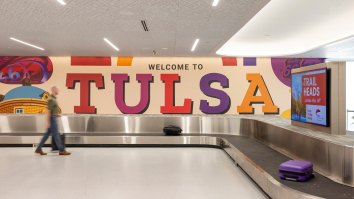
Elizabeth: The scope and our role can also be quite different. We recently finished a project at Tulsa International Airport that added a Federal Inspection Service (FIS) facility for U.S. Customs and Border Protection, allowing the airport to start accepting international commercial flights. This was their first time going through that process, so our role was much more than just designing the facility, we helped them understand and navigate a process that was completely new to them. We’ve delivered FIS facilities and international work at larger hubs, too, but those airports have typically been through the process before.
At a regional airport, you can be there from the beginning, helping the client understand the requirements, navigate regulatory processes, and determine the best path forward. Then you get to see firsthand what that investment means for the airport and the community. That’s a pretty unique opportunity.
Ross: Because of the way regional airports are funded, through FAA grants and discretionary spending, a project may be broken into a series of projects over many years. For our renovation at Lawton Ft. Sill Regional Airport, our goal was to keep flights operational during construction and then provide a more cohesive experience for travelers with the final product. Rather than doing it all at once like we might at a larger facility, we implemented the project in phases to match funding streams. It was a slower timeline, but it worked better for this specific client and what they needed.
IS THE DESIGN DIFFERENT? HOW SO?
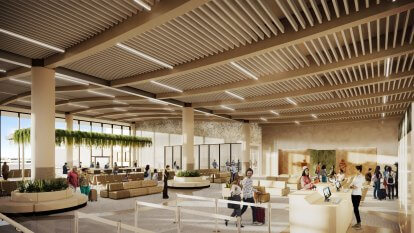
Brian: The airport is the front door of tourism to these areas. On our Charleston International Airport project, a key consideration for our design was the idea that when you are visiting, the airport is the first and last place you experience. The community has a strong sense of history and local pride. In design, that translates to more regionalization: Charleston is a coastal town, and they have the lowcountry landscape that greatly influenced our selection of materials and colors in the design to have a more playful feel than you sometimes get at a global hub.
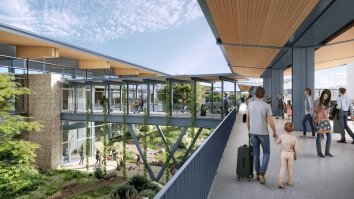
Elizabeth: While we do see larger airports incorporate regional elements, it can be harder to establish a single, unified sense of place at that scale. Our work at San Antonio International Airport is a great example of a larger city where that regional identity is still very strong. The city has such a distinct history, culture, and connection to the surrounding landscape, and we’ve been able to bring those elements into the design so that when you step off the plane, you know exactly where you are. It’s a good reminder that it’s not necessarily about the size of the city. It’s about how distinctive its identity is and how connected the airport can be to the community it serves.
HOW DOES CORGAN'S EXPERIENCE WITH LARGE AIRPORT PROJECTS SERVE REGIONAL CLIENTS
Elizabeth: Our regional clients know their city and their airport really well, but looking ahead and planning for what comes next can be a significant challenge. That’s where our broader experience can help them step back and look at the bigger picture. At San Antonio, for example, we helped develop the complete terminal development program to look at how planning, phasing, existing facilities, connections, and future needs would all fit together. Sense of place and accessibility were both important to that client, so we were able to take those priorities and think about them holistically as part of the overall plan.
Because we have that broader planning experience, we can sit down with a client, understand where they want to go, and help figure out how to get there. We can bring lessons from working on larger, more complex airport projects and apply them in a way that makes sense for each regional airport and what’s important to their community.
At the hubs, there is a set process for visioning, stakeholder alignment, and long-term planning. Those skills are valuable to our regional clients, but the most important piece is that we are able to scale that process to fit regional airport projects.
Brian: At the hubs, there is a set process for visioning, stakeholder alignment, and long-term planning. Those skills are valuable to our regional clients, but the most important piece is that we can scale that process to fit their project. Beyond the actual design, a big part of our role is being an advisor through decisions they may not make often, whether that means navigating the process with them, helping better understand tradeoffs, or giving them confidence to make the right call for their community. You may think you know what you want to get out of a visioning session, but that can yield a whole new set of priorities — we help airport directors and their teams work through those priorities so the planning and design can be more focused. If we do that well, we set the table for them by creating the right framework, and they get to bring their own priorities and sense of place to it.
Ross: In addition to the planning aspect, we get to transfer our knowledge of the cutting-edge technologies that hub airports are incorporating. Working at large airports keeps us close to the innovations and emerging technology shaping the industry. We can bring that knowledge to regional clients in a practical way, scaling the right ideas to fit their needs and long-term goals.