Applied Research: EPScrete in Action
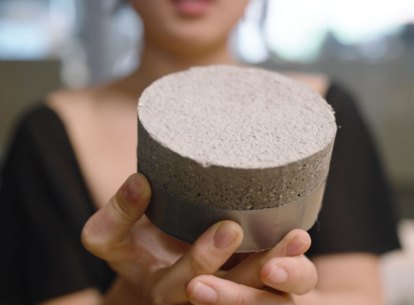
As Corgan—Hugo’s inaugural Curiosity in Design Research Fellow, Amy Qu investigated the properties of EPScrete — a lightweight concrete that incorporates expanded polystyrene (EPS) beads instead of aggregate. Her research project explored how EPScrete could contribute to ongoing industry-wide conversations around circularity, resource efficiency, and material innovation in the built environment.
Two wrongs make a right
Between operational emissions and the embodied carbon in materials such as concrete, the built environment is responsible for nearly 40% of global carbon dioxide emissions. Amid growing urgency around climate change and the environmental cost of construction, the search for alternative building materials has accelerated, with bio-based concretes and mass timber as prominent examples. Expanded polystyrene (EPS), more commonly known as Styrofoam, is a persistent source of landfill waste: only 6% of the 80,000 tons of EPS waste generated annually was recycled in 2018. It is not biodegradable, but instead gradually breaks down into microplastics, leaching harmful chemicals into the environment. This research sought to solve one problem with another. By reusing shredded EPS as an aggregate in concrete, a new pathway for EPS recycling is established while also creating something new: EPScrete, a lightweight, potentially lower carbon material with promising thermal and acoustic properties.
Something old, something new
Importantly, this research does not position EPScrete as a replacement for traditional concrete. Instead, it illustrates that research can surface new opportunities at the intersection of sustainability and design. EPScrete becomes a case study in looking differently at the materials we already have, and imagining futures where waste is a new beginning, rather than an endpoint. Instead of a structural material, EPScrete has potential to support non-structural applications, prefabricated elements, and environments where lightness, acoustic performance, or thermal insulation are priorities.
One of the key advantages of EPScrete is that it is lighter than traditional concrete, making it a promising option to reduce the weight on non-structural components. Its reduced mass suggests it should be treated as an acoustic or insulating composite ideal for lightweight, interior, or hybrid assemblies where its thermal insulating and acoustic dissipating properties can be fully applied.
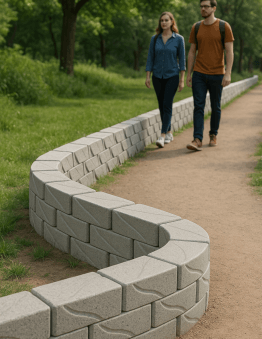
“Right off the bat, you can use something like [EPScrete] for precast furniture. It's something that can be lightweight, movable, durable for exterior application, and easy to move. It's very good for outdoors, retaining wall applications, exterior applications, parks, landscaping, planters.”
Potential use cases
Though EPScrete requires more research and testing before it is ready for commercial production, the results of this study show that it could have applications in precast furniture, landscape architecture, and even as a non-structural element in larger buildings.
When considering its demonstrated qualities, the potential for other, larger applications arise. The initial study’s results, along with current uses of EPS, indicate a number of possibilities for potential future commercial uses of EPScrete:
For the typical Type I concrete and steel tower, up to 40% of the façade is precast concrete panels. These panels are affordable and relatively shapable but they are heavy, putting limits on the size and thickness of the panels for liftability and necessitating a robust superstructure to carry the concrete panels. A lightweight material like EPScrete can reduce the load of the skin, allowing material savings for the superstructure. It could also allow for more dramatic profiles and geometries than typical precast concrete, since it is less limited by liftability.
Structurally insulated panels (SIPs) are already used in residential and light commercial construction and can accept a wide range of interior and exterior finishes. When concrete panels are used as the finish for this structure, it is often just a smooth finish panel. EPScrete could offer a new look and articulation opportunities for the exterior layer. This panelized approach is cost effective, but incorporating EPScrete could also make it a sustainable and beautiful method.
Given EPScrete’s acoustic properties, another potential use case for the mid-rise wrap-around configuration that is typical in multifamily buildings. The steel-structure parking garage core is “wrapped” with residential wood construction. The garage is usually separated from the residential portion with precast concrete as a noise dampener. Since this is not a structural element, but rather an acoustic barrier, EPScrete could be a strong alternative to typical precast.
EPS materials are already being used as insulation for concrete roofs, but these materials are brand new, not recycled. Given the demonstrated benefits of EPS in this application, EPScrete could prove to be a more sustainable option due to its recycled EPS content. It could also prove to be a simple, cost effective swap for designs that would normally use EPS as part of an insulation system.
Creating a “living wall” by cultivating moss or plant life on a porous concrete panel has been explored in other concrete formulations, but was not addressed in this research. The material’s porosity, strength, and surface characteristics would need to be investigated to determine if it can support durability requirements for this type of application, but it is a promising potential use case. This type of biophilic design is also popularly used to mitigate sound, meshing nicely with EPScrete’s acoustic properties.
Keeping innovation at the forefront
EPScrete is an evolving material with potential to support non-structural applications, prefabricated elements, and environments where lightness, acoustic performance, or thermal insulation are priorities. With potential applications in commercial, multifamily, and landscape architecture projects, this research starts a valuable conversation around using unconventional materials to reduce the carbon footprint of the AEC industry and opens up possibilities for further research into new and innovative materials.