A New Terminal 6 for John F. Kennedy International Airport
Project Stats
- Location
New York, New York
- Size
1.2 million SF
- Partners
JFK Millennium Partners (a consortium led by Vantage Group and RXR Realty)
- Market
- Expertise
Architecture
Aviation Planning
Climate, Sustainability & Wellness
New York's new civic gateway
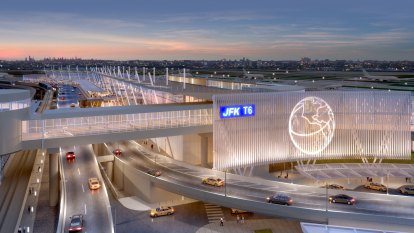
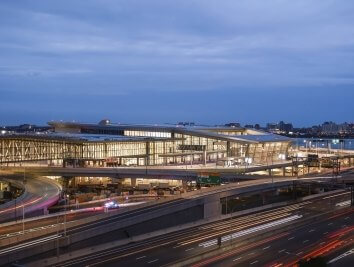
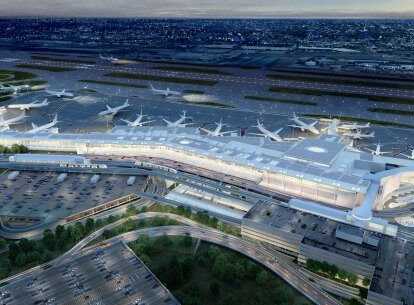
The new JFK Terminal 6 represents a new era of global travel shaped by movement, light, technology, and a distinctly New York sense of place. As part of the Port Authority of New York and New Jersey’s transformation of JFK, the 1.2 million-square-foot terminal reimagines the passenger journey with architecture that is both intuitive and operationally advanced.
Rising beside Eero Saarinen’s 1962 landmark TWA Flight Center, Corgan’s design of Terminal 6 celebrates its neighbor through contrast and respect, rather than mimicry. Clear lines, expansive transparency, and a confident civic presence establish a modern counterpart to Saarinen’s sculptural form. Together, the two terminals create a dialogue across generations — honoring the past while welcoming the future.
A fresh start for a historic site
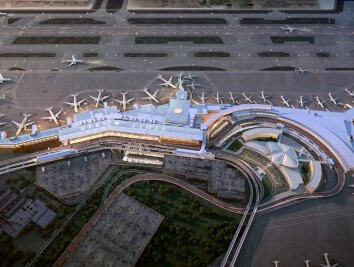
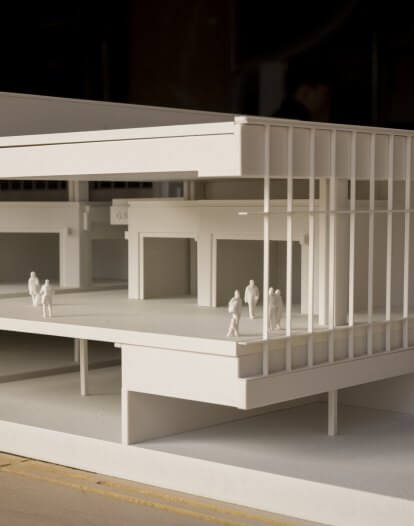
The new terminal is located on the combined sites of the former Terminal 6 — a 1960s facility designed by I.M. Pei known as the “Sundrome” demolished in 2011 — and the existing Terminal 7, which is being demolished as part of the project. The three-level headhouse contains all processor functions for the terminal while the concourses are two-level structures with an interstitial level that houses the sterile corridor system.
The new terminal will accommodate 10 international wide-body contact gates, three of which are MARS (Multiple Apron Ramp System), providing flexibility for three additional gated aircraft. The project also includes a significant redesign of airfield taxiways, taxi lanes, and ramp infrastructure, a new roadway network serving both departing and arriving passengers, a seamless tie-in to the existing Terminal 5, and connections to two existing AirTrain stations. These improvements expand JetBlue’s operations and enhance transfer efficiency across terminals.
Terminal 6 will pursue LEED Gold certification and supports the Port Authority’s Net Zero Roadmap to reduce greenhouse gas emissions by 2050. Sustainable strategies being integrated into the design include a solar photovoltaic system, aircraft de-icing and fluid recovery, and stormwater reclamation system. Inside the terminal, high efficiency lighting, baggage system motors, and automated building controls will further help conserve energy.
Designed for flight and light
The terminal's design is intentionally monumental, fit for its role as a major gateway to a world-class city like New York. The three-level headhouse is topped with an angled, wing-like roof that is both a gesture and the result of forces resolved — span, lift, and enclosure held in balance. The angle of the roof extends over the concourses, creating a continuous field of movement that frames the building as an instrument of passage.
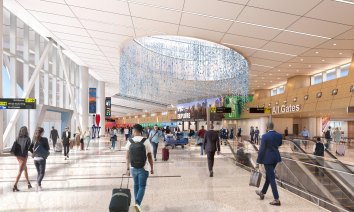
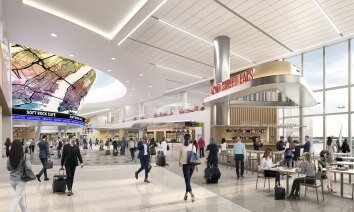
In response to site constraints, the team developed a linear plan that is conceived as a sequence of rooms that intuitively move passengers through the airport. The passenger’s journey features plentiful natural light, intuitive wayfinding elements, grand spaces, and a sense of place that draws from the rhythm and vitality of New York City. Architecture and circulation are conceived as a choreographed sequence in which structure, daylight, and passenger flow work together to create an intuitive journey.
Carefully choreographed
With the passenger journey organized into a series of interconnected civic spaces, each space took on its own character, scale, and purpose. Corgan’s research and innovation group, Hugo, contributed advanced analytics to shape the passenger journey: Movement studies, dwell-time mapping, and decision-point analysis informed planning strategies that improve flow, reduce stress, and enhance comfort.
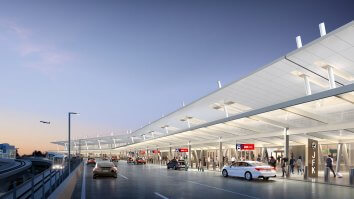
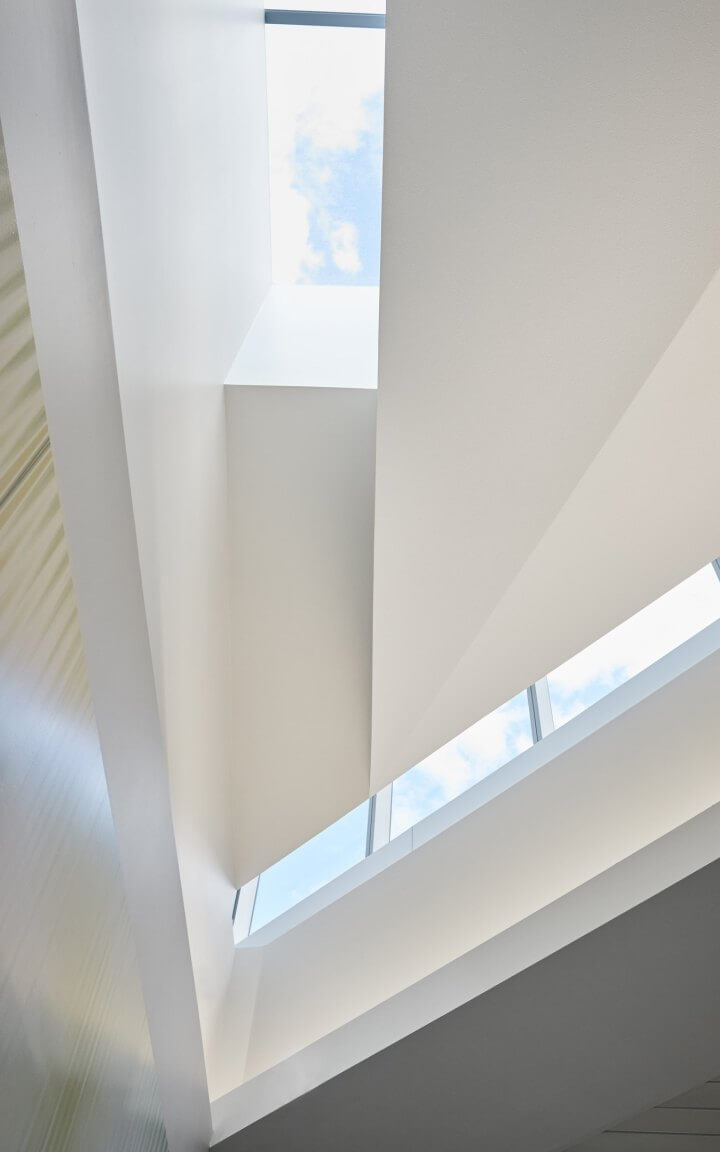
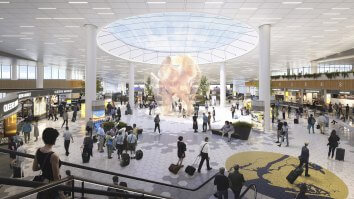
Departing passengers benefit from generous curb frontage and check-in counters, united under the “wing” of the roof and canopy. The central security checkpoint, announced by a grand oculus, minimizes walk distances and provides glimpses to the airfield beyond to keep passengers oriented and reduce anxiety. After clearing security, passengers descend one level into the East Hall, featuring another large oculus and monumental art curated for the terminal as well as New York-themed concessions and duty-free shopping. This spacious, central space serves as the heart of the terminal and a place for passengers to pause, look up, and re-orient themselves.
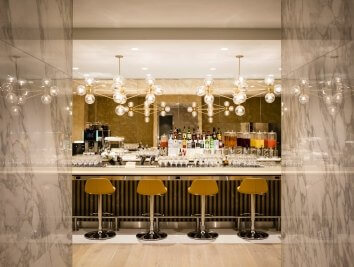
From the East Hall, passengers access the concourse, organized with concessions and other amenities along one side and gates with views to the airfield on the other. The concourse is linear but not monotonous. Its scale, openings, amenities, and views create variation along the journey and it carries the passenger forward while allowing moments of pause, creating a balance between efficiency and leisure. Additional food and beverage offerings, retail, art installations, and other features along the concourse provide an enticing diversion as passengers wait for their flights.
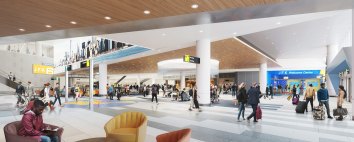
For arriving domestic passengers, the bustling Center Hall is anchored by an inverted cone visible from both directions to help mark the transition from airside to the no re-entry area. Rather than treating this boundary as a purely operational device, the design — along with public art installations — transforms it into a landmark where flows converge without confusing passengers along their journeys.
For arriving international passengers, a spacious sterile corridor featuring dynamic airfield views and glimpses of the concourse welcomes travelers to the United States. A multi-story atrium leads the passengers into the Customs and Border Protection facility and baggage claim area. Upon exiting, passengers enter a grand arrivals hall that gently returns the terminal to the language of the city. Its character is shaped by the idea of the High Line — a reclaimed urban landscape where infrastructure, movement, nature, and public space are woven together. With access to meeters and greeters, an arrivals lounge, and ground transportation services, the hall is designed to transform the end of the air journey into the beginning of an urban one.